
By BlueSky Roofing & Siding Solutions | Serving Passaic County | (201) 686-1059
Paterson, NJ is a city built on brick. From the historic mills near the Great Falls to the Victorian-era row homes in the Fourth Ward to the mid-century colonials stretching east toward Clifton, brick construction is woven into the character of nearly every Paterson neighborhood. And where there is brick, there are chimneys — hundreds of thousands of them — quietly deteriorating on rooftops across Passaic County while homeowners have no idea what’s happening six feet above their heads.
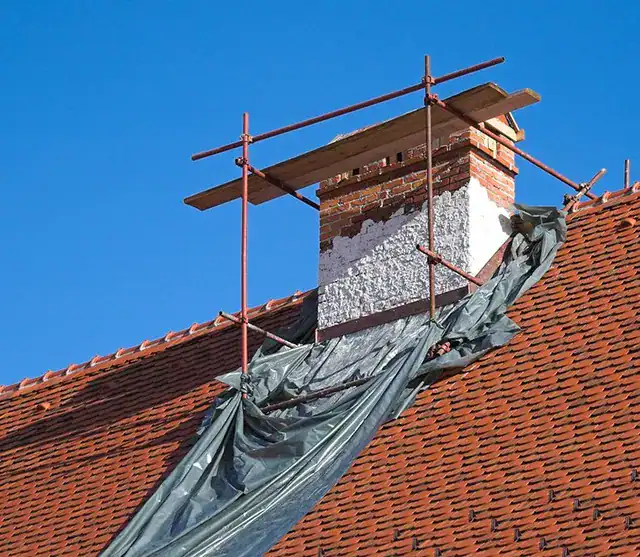
Chimney problems are the most underdiagnosed source of water damage in Paterson homes. Unlike a leaking pipe or a missing shingle, chimney failure is silent and slow. Water enters through cracked mortar joints, a deteriorated chimney crown, failed flashing, or an open chimney cap — and it travels down through the masonry, into the attic, through the ceiling, and sometimes all the way into the basement before anyone notices. By that point, a $600 repair has become a $6,000 structural remediation project.
This guide is written specifically for Paterson homeowners. We’ll cover the most common chimney problems in Passaic County homes, what they cost to fix, how to find a legitimate chimney repair contractor in Paterson, and the specific signs that mean you need to act now — not next spring.
Why Chimney Problems Are So Common in Paterson, NJ
Paterson’s housing stock is one of the most diverse in New Jersey — a mix of pre-1900 brick row homes near downtown, early-20th-century two-families throughout the core neighborhoods, and mid-century suburban colonials in areas like Eastside and Totowa Road. Every one of these building types has chimneys, and every one of those chimneys is subject to the same relentless forces:
1. Passaic County’s Freeze-Thaw Cycle
Northern New Jersey typically experiences 60 to 80 freeze-thaw cycles per winter season. Each cycle causes brick and mortar to expand and contract. Over time — especially over the 50 to 100 winters that many Paterson chimneys have endured — this physical stress causes mortar joints to crack and crumble, bricks to spall (chip and flake), and chimney crowns to crack open at the top. Once water has an entry point in masonry, it accelerates dramatically: water infiltrates, freezes, expands, and forces the crack wider each winter.
2. The Age of Paterson’s Housing Stock
A very large proportion of Paterson’s residential properties were built before 1950. Chimneys on these homes were constructed with older mortar formulations that have a finite lifespan — typically 25 to 30 years for the mortar joints in the most exposed upper sections. Even chimneys that were repointed once or twice in the last century may now be at or past their next maintenance cycle. The average Paterson homeowner has not had their chimney professionally inspected in over 10 years — often much longer.
3. Flat and Low-Slope Rooflines
Many of Paterson’s urban row homes and converted multi-families have flat or near-flat roofs. The chimney penetrates this roof at a right angle, and the flashing seal at the base of the chimney is the most common water entry point on the entire property. On flat-roofed Paterson properties, the chimney-to-roof junction is exposed to pooling water in a way that a chimney on a pitched suburban roof simply isn’t. If you have a flat roof in Paterson, your chimney flashing deserves inspection every two to three years.
Our team handles both the roofing and masonry components of this repair together. For the roofing side of chimney flashing, see our roof leak repair page.
4. Deferred Maintenance on Rental Properties
Paterson has a significant proportion of rental housing stock — two-family and three-family homes where the owner may live out of town and the tenants have no visibility into roof and chimney conditions. Deferred maintenance on chimneys is especially common in this segment of Paterson’s housing market, and it means our team regularly encounters chimneys that haven’t been touched in 20 or 30 years when we arrive for an inspection.
8 Signs Your Paterson Chimney Needs Repair Right Now
You don’t need to climb onto your Paterson roof to identify most of these warning signs. Several are visible from inside your home or from the street:
Sign 1: White Staining on the Brick (Efflorescence)
That chalky white residue you see on chimney brick or exterior masonry walls is called efflorescence — it’s the mineral salts left behind when water moves through masonry and evaporates at the surface. Efflorescence itself is not structural damage, but it is a 100% reliable indicator that water is actively moving through your chimney’s masonry. Every time you see white staining, water is already inside the brick. Don’t ignore it.
Sign 2: Crumbling or Missing Mortar Joints
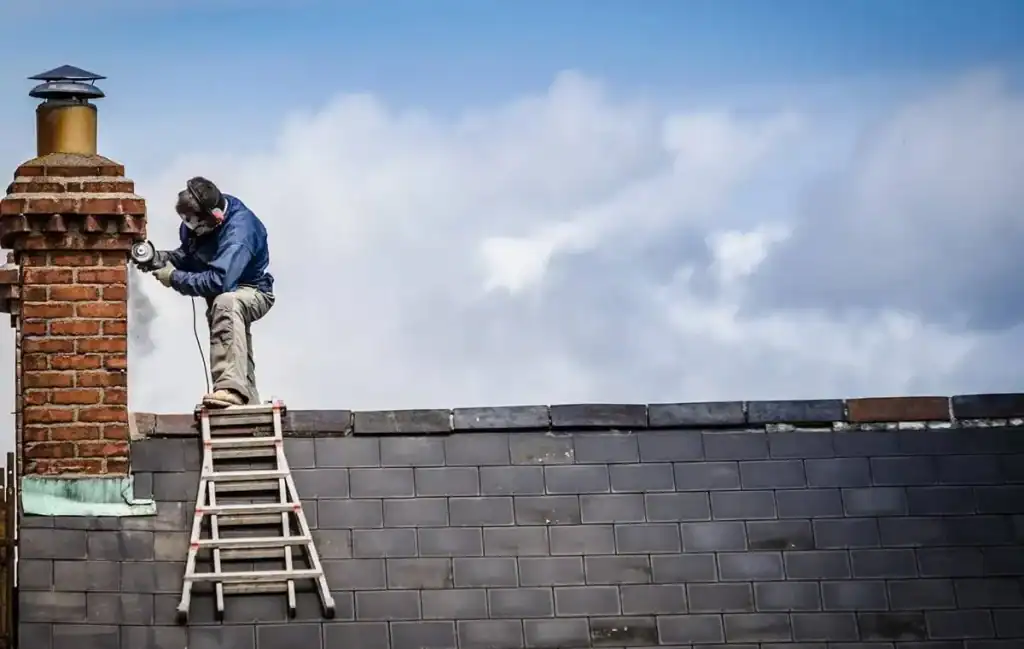
The mortar between your chimney’s bricks is not a permanent material — it has a lifespan and it deteriorates. When mortar joints crumble, crack, or fall out, the individual bricks are no longer bonded and supported correctly, and every gap is an open invitation for water. On Paterson chimneys, we commonly find mortar deterioration beginning in the uppermost 18 to 24 inches of the chimney — the section that takes the most weather exposure — even when lower sections look intact.
The repair for deteriorated mortar is called tuckpointing (or repointing): old mortar is carefully removed to a depth of about 3/4 inch, and new mortar is packed in and tooled to match. When done correctly by a skilled mason, tuckpointing can extend a chimney’s life by another 25 to 30 years.
Sign 3: Cracked or Deteriorated Chimney Crown
The chimney crown is the concrete or mortar cap that covers the top of the chimney around the flue opening. It’s the chimney’s first line of defense against weather, and it’s one of the first components to fail. Cracks in the crown allow water direct entry into the chimney structure. On Paterson homes from the early and mid 20th century, many original chimney crowns were built with a substandard mortar mix (rather than proper concrete) that degrades faster and is far more susceptible to freeze-thaw cracking.
A cracked crown can often be repaired with a professional-grade crown sealant if the damage is minor. More significant cracks or a crown that has begun to shift or separate require full crown replacement — a relatively affordable repair that prevents significant water damage.
Sign 4: Damaged or Missing Chimney Cap
The chimney cap is the metal or concrete cover that sits over the flue opening at the very top of the chimney. Its purpose is to keep rain, snow, birds, and animals out of the flue. A missing, damaged, or improperly fitted chimney cap means your flue liner is directly exposed to precipitation. On Paterson homes with wood-burning fireplaces or gas appliances venting through the chimney, an uncapped flue also allows animals to nest in the flue — a fire and carbon monoxide hazard.
Chimney cap replacement is one of the least expensive chimney repairs, but it’s one of the highest-impact in terms of preventing future damage. If your Paterson home’s chimney cap is missing or visibly damaged, this is a same-season repair — don’t let it go another winter.
Sign 5: Water Stains on the Ceiling or Walls Near the Chimney
This is the interior warning sign that drives most Paterson homeowners to call us. Yellow, brown, or gray water staining on a ceiling near the fireplace or on the wall adjacent to the chimney stack is a clear indicator of active water infiltration. The stain may appear intermittently — showing up during heavy rain or snowmelt and then drying out — which leads some homeowners to dismiss it as a minor issue. It isn’t minor. Intermittent water intrusion still causes wood rot, mold, and structural deterioration in the framing around your chimney.
Sign 6: Spalling Bricks
Spalling is the process by which bricks flake, chip, or pop apart from the face. It’s caused by water freezing inside the brick and forcibly fracturing the surface. Spalling bricks on a Paterson chimney are a sign that freeze-thaw damage has reached the interior of the masonry — meaning the brick’s outer fired surface (the hardest, most weather-resistant layer) has been compromised. Spalled bricks need to be removed and replaced; they cannot be repaired with sealant or mortar alone.
Sign 7: Rust on the Damper or Firebox
If you open your fireplace damper and see rust — on the damper plate itself, on the firebox walls, or on the smoke chamber above — this tells you that water has been entering the chimney from above and running down the inside of the flue. This is a clear sign of either a missing chimney cap, a cracked crown, or deteriorated flashing. The damper can be replaced, but the more important repair is identifying and stopping the water entry point at the top of the chimney.
Sign 8: Visible Gaps or Separation in the Chimney Flashing
From the ground or from a safe attic window view, examine where your chimney meets your roof. The metal flashing that seals this junction should be continuous, tight against the masonry, and fully sealed. Any visible gaps, bent or lifted sections, or separation between the flashing and the chimney face is a water entry point. On Paterson homes with flat roofs, flashing failure is the single most common chimney-related leak source — and it’s often misdiagnosed as a roofing problem when the actual repair involves the chimney masonry.
BlueSky’s team handles both the masonry and the roofing components of chimney flashing repair. See our full chimney repair service page for details.
Types of Chimney Repair: What Paterson Homeowners Should Know
Tuckpointing / Repointing
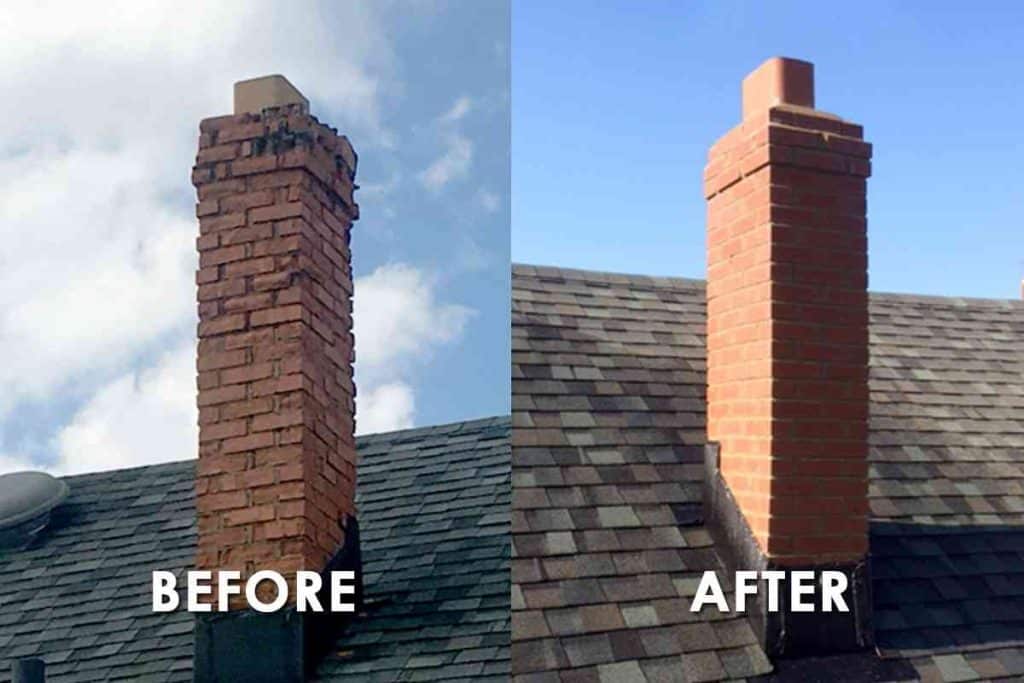
Tuckpointing is the process of removing deteriorated mortar from chimney joints and replacing it with fresh mortar. It’s the most common chimney repair performed on Paterson’s older brick homes and is often the repair that extends a chimney’s functional life by decades. Done correctly, new mortar is matched to the color and profile of original joints and packed to a depth that ensures a weathertight bond. Done poorly — with the wrong mortar mix or insufficient depth — tuckpointing fails within a few years.
The critical detail most homeowners don’t know: mortar strength must be matched to the age and type of brick. Historic Paterson homes from the early 20th century typically used softer lime mortars. Using modern Portland cement mortar on these older bricks creates a mismatch in hardness — the mortar ends up harder than the brick, and freeze-thaw stress causes the brick face to crack rather than the mortar joint. A contractor who doesn’t account for this will damage your Paterson home’s historic masonry.
Chimney Crown Repair or Replacement
Minor crown cracks (hairline to 1/4 inch) can often be sealed with a professional-grade elastomeric crown coat product applied by an experienced mason. Larger cracks, crumbling sections, or a crown that is structurally failing require complete crown demolition and replacement with a properly mixed concrete crown that overhangs the chimney face with a drip edge. A correct chimney crown is one of the most effective investments in chimney longevity — it prevents the majority of water entry issues at the top of the chimney.
Chimney Flashing Repair or Replacement
Chimney flashing is a multi-component system: base flashing (step flashing running up the sides of the chimney), counter-flashing (metal embedded into the chimney mortar joints that overlaps the base flashing), and saddle or cricket flashing (on the uphill side of wider chimneys). Repairing just one component while leaving the others in deteriorated condition leads to recurring leaks. A complete flashing replacement on a Paterson residential chimney involves removing all existing flashing, cleaning the masonry joints, and installing new step and counter-flashing in a properly interlocked system.
This work is handled by our integrated roofing and masonry team. Learn more on the chimney repair page.
Chimney Liner Repair or Replacement
The chimney liner is the interior flue that conducts combustion gases from your appliance to the outside. Original terra cotta tile liners in older Paterson homes can crack from thermal shock (especially if there’s been a chimney fire, even a minor one), from settling, or from long-term moisture damage. A damaged liner is a serious safety issue — combustion gases can leak into the living space. If your Paterson home has a gas furnace or water heater venting through the chimney, a damaged liner also creates carbon monoxide risk. Liner repair typically involves stainless steel liner installation inside the existing flue.
Partial or Full Chimney Rebuild
When tuckpointing and crown repair are no longer sufficient — when bricks are spalling extensively, when the top section of the chimney has structurally separated, or when the chimney has settled and shifted — a partial or full rebuild is required. On Paterson homes with severely deteriorated upper sections, a partial rebuild (removing the top 2 to 4 feet and rebuilding with new brick and mortar) is often the most cost-effective path to a chimney that will last another 50 years.
Our masonry team specializes in chimney rebuilds that match historic Paterson brick profiles. See the full range of masonry services we offer.
Chimney Repair Cost in Paterson, NJ: Real 2026 Price Ranges
The following estimates reflect current pricing for chimney repair work in Passaic County. These are legitimate contractor prices — not lowball estimates from unlicensed crews or inflated figures from national aggregator sites:
- Chimney cap replacement: $250 to $600 depending on flue size and cap style
- Chimney crown repair (sealant/coat): $300 to $700 for minor to moderate cracking
- Chimney crown replacement (full demolition and rebuild): $800 to $1,800
- Tuckpointing / repointing (upper section, typical residential chimney): $600 to $1,800 depending on height access and scope
- Full chimney tuckpointing (entire chimney face): $1,500 to $4,000+
- Chimney flashing replacement: $500 to $1,500 for a standard residential chimney
- Partial chimney rebuild (top 2 to 4 feet): $1,800 to $4,500
- Full chimney rebuild from roofline: $4,000 to $12,000+ depending on height and complexity
- Stainless steel liner installation: $1,500 to $4,000 depending on flue height and diameter
These are general ranges. BlueSky Roofing provides free on-site chimney inspections for Paterson homeowners, and all estimates are written and itemized with no pressure to commit.
A word on the low end of the market: in Paterson and throughout Passaic County, homeowners are regularly approached by unlicensed ‘chimney crews’ who quote dramatically low prices — $200 tuckpointing, $150 crown coats — and perform work that looks acceptable from the ground but fails within one or two winter seasons. These crews often use improper mortar mixes, skip critical prep work, and carry no insurance. If you’re injured on your property or if their work causes water damage, you have no recourse. Always verify NJ contractor licensing before any chimney work.
Paterson Neighborhoods: Chimney Issues We See Most Often
Downtown Paterson and the Fourth Ward
These neighborhoods contain some of Paterson’s oldest residential housing — brick row homes and two-families built between 1880 and 1920. Chimneys on these properties are original masonry construction, and many have never had a comprehensive inspection. Tuckpointing need is near-universal on any chimney over 40 years old in this part of Paterson. Many also have coal-conversion history — chimneys that were originally designed for coal were later adapted for oil or gas, sometimes without proper liner assessment.
Eastside Paterson
Eastside Paterson’s housing stock trends toward mid-century colonials and split-levels — similar to the suburban build patterns you’d find in neighboring Clifton or Totowa. These homes have brick chimneys from the 1950s through 1980s construction era. The most common issues here are failed chimney crowns (many original crowns on these homes are now 40 to 70 years old and have never been replaced), outdated metal chimney caps, and aging counter-flashing that has separated from the chimney mortar joints.
North Paterson and Haledon Border
The northern sections of Paterson, along the border with Haledon and Prospect Park, have denser tree coverage. We frequently encounter moss and vegetation growth at the base of chimneys in these neighborhoods — a sign of chronic moisture retention that accelerates mortar joint failure. If your Paterson chimney has visible green or black biological growth, the underlying mortar joints almost certainly need attention.
Historic District / Great Falls Area
Properties near the Paterson Great Falls National Historical Park area may fall under historic preservation guidelines. If your property is in or adjacent to a locally designated historic district, material selection for chimney repair — including mortar formulation and brick replacement sourcing — may need to comply with preservation standards. BlueSky’s masonry team has experience with historic-sensitive work and can advise on appropriate material specifications.
Why Paterson Homeowners Should Not Wait Until Spring
One of the most common mistakes we see from Paterson homeowners is the decision to ‘wait until spring’ to address chimney issues noticed in the fall or winter. This reasoning feels logical — masonry work is often best done in moderate temperatures, and spring seems like the natural time. But the reality is that every winter cycle you allow a damaged chimney to endure makes the problem significantly worse, not the same.
Here’s what happens to an unrepaired Paterson chimney over a single winter:
- A hairline crack in the chimney crown absorbs water in fall rain. That water freezes in the first hard frost and expands, widening the crack. By February, a 1/8-inch crack can become a 1/2-inch gap with loose concrete sections. A $400 crown coat repair becomes a $1,400 crown replacement.
- A compromised mortar joint on the upper chimney section allows water infiltration in November. Freeze-thaw cycling from December through March forces the joint wider. By spring, brick faces are beginning to spall. A $800 tuckpointing job becomes a $2,500 tuckpointing-plus-brick-replacement project.
- Failed flashing allows water to run down the chimney wall and into the attic framing through the winter. Six months of moisture exposure to the wood framing around the chimney creates conditions for mold and wood rot. What began as a $700 flashing replacement becomes a $700 flashing replacement plus $3,000 in carpentry and mold remediation.
The moral is consistent: chimney repair costs scale dramatically when damage is allowed to progress through winter. If your Paterson home’s chimney has any of the warning signs described in this guide, the economically sound decision is to schedule an inspection and address repairs before the next freeze-thaw season begins.
Why Paterson Homeowners Trust BlueSky Roofing & Siding for Chimney Work
BlueSky Roofing & Siding Solutions is a family-owned New Jersey contractor headquartered at 310 Colfax Avenue, Clifton, NJ — just minutes from Paterson’s eastern neighborhoods. We have served Passaic County homeowners for over 45 years. We are fully licensed with the New Jersey Division of Consumer Affairs and carry comprehensive general liability and workers’ compensation insurance on every project.
Our chimney work is performed by experienced masonry professionals — not subcontractors, not day laborers hired for a single job. When BlueSky takes on a chimney repair project in Paterson, the same licensed team that inspects your chimney is the team that does the work and signs off on the completion.
We specialize in the specific chimney types and conditions common to Passaic County’s diverse housing stock — from the early-20th-century brick construction of downtown Paterson’s row homes to the mid-century colonial chimneys of Eastside neighborhoods. We understand the mortar formulations appropriate for older brick, the flashing systems suited to flat-roofed urban properties, and the historic preservation considerations that apply in certain Paterson districts.
Read reviews from homeowners across Passaic County on our reviews page.
Browse completed chimney and masonry projects in our Our Work gallery.
Schedule Your Free Chimney Inspection in Paterson, NJ
If your Paterson home’s chimney shows any of the warning signs in this guide — or if it hasn’t been professionally inspected in the last three years — schedule a free, no-obligation inspection with BlueSky Roofing & Siding Solutions today.
Our licensed inspectors will assess your full chimney system, document all findings in writing, and give you honest recommendations with transparent pricing. No pressure. No upselling. Just a clear picture of what your chimney needs and what it will cost.
We serve all Paterson neighborhoods including Downtown, Eastside, North Paterson, Sandy Hill, Bunker Hill, and the areas bordering Clifton, Haledon, and Prospect Park.
For all Passaic County roofing, siding, and masonry services, visit our Passaic County service page.
Phone: (201) 686-1059
Free Estimate: https://blueskyroofingsiding.com/contact-us/
Address: 310 Colfax Ave, Clifton, NJ — serving all of Passaic County

