
Quick answer: If a leak shows up near your chimney during or shortly after rain, failed chimney flashing is one of the first areas that should be inspected. Common clues include brown ceiling stains beside the chimney, damp roof decking in the attic, peeling paint, deteriorated sealant, loose metal at the chimney base, and leaks that return after someone simply applies more caulk. In Somerville, older masonry chimneys and repeated New Jersey freeze-thaw cycles can make the roof-to-chimney joint especially vulnerable. The correct repair may involve step flashing, counter-flashing, shingles, underlayment, or nearby masonry—not just surface sealant.
A roof leak around a chimney is frustrating because the place where water appears indoors is not always the place where it entered. Water can slip behind failed metal flashing, travel along roof decking or framing, and finally show up several feet away as a ceiling stain. That is why a “chimney leak” can be misdiagnosed as a shingle problem, a masonry problem, or even an attic condensation issue.
For Somerville homeowners, the most useful question is not simply “Is my chimney leaking?” It is “Which part of the chimney-roof system is allowing water in?” Chimney flashing, the crown, mortar joints, the cap, shingles, roof decking, and gutters can all create similar symptoms. A good inspection separates those causes before any repair begins.
BlueSky Roofing & Siding Solutions serves homeowners across New Jersey, including Somerset County. This guide goes deeper than our general roof leak repair guide by focusing specifically on chimney flashing problems, the warning signs Somerville homeowners can see, and how a lasting repair should be approached.
What Is Chimney Flashing, and Why Does It Leak?
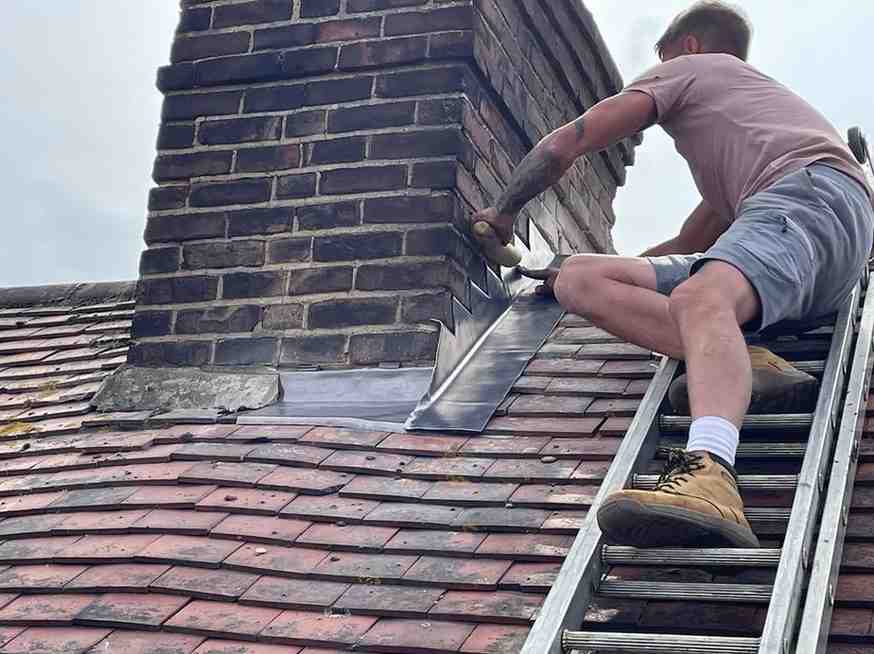
Chimney flashing is the waterproofing system installed where the roof surface meets the masonry chimney. That intersection is difficult because two very different materials meet there. Roofing materials shed water down the slope, while a masonry chimney rises vertically through the roof. The joint has to move through heat, cold, wind, rain, snow, and normal building expansion without opening a path for water.
Step flashing protects the roof side of the joint
Step flashing is made from individual pieces of metal woven into the shingle courses along the sides of a chimney. Each piece overlaps the one below it so water is directed back onto the shingles. When step flashing is missing, too short, corroded, nailed incorrectly, or reused after a roof replacement, water can work behind the shingles and enter the roof deck.
Counter-flashing protects the masonry side
Counter-flashing covers the upper edge of the step flashing and is integrated into the chimney masonry. Proper counter-flashing prevents rain from running down the brick or stone and behind the roof flashing. If it pulls away, rusts, is poorly embedded, or is replaced with a bead of roofing cement instead of proper metal work, the joint may leak again even after a temporary patch appears to work.
The uphill side may need a cricket or careful back-pan detail
The back of the chimney—the side facing uphill—takes concentrated runoff. On wider chimneys, a small peaked structure called a chimney cricket can split water and send it around both sides instead of allowing water or snow to collect behind the masonry. Even where a cricket is not required, the back-pan flashing has to be sized and integrated correctly. This area is a frequent source of leaks after heavy or wind-driven rain.
9 Signs Your Chimney Flashing May Be Causing the Roof Leak
1. A brown or yellow ceiling stain appears near the chimney
One of the classic signs of a roof leak around a chimney is a brown, yellow, or gray water stain on the ceiling or upper wall near the chimney chase. The stain may darken during storms and fade as the area dries. Do not rely on the exact stain location to identify the entry point; water often travels along wood framing before it becomes visible indoors.
2. The attic decking is damp beside the chimney
If the attic is safely accessible, darkened plywood, damp roof boards, wet insulation, rusty nails, or a musty odor around the chimney can point to a persistent leak. Moisture on the uphill side of the chimney often deserves special attention because that area receives roof runoff. Older plank roof decking can also hold moisture in joints, making the source harder to see from below.
3. The leak gets worse during wind-driven rain
A leak that appears only during certain storms can still be a flashing problem. Wind can push rain against the chimney face and into small gaps that stay dry during light vertical rainfall. Loose counter-flashing, open mortar joints, and failed sealant at metal transitions often become much more obvious during driving rain.
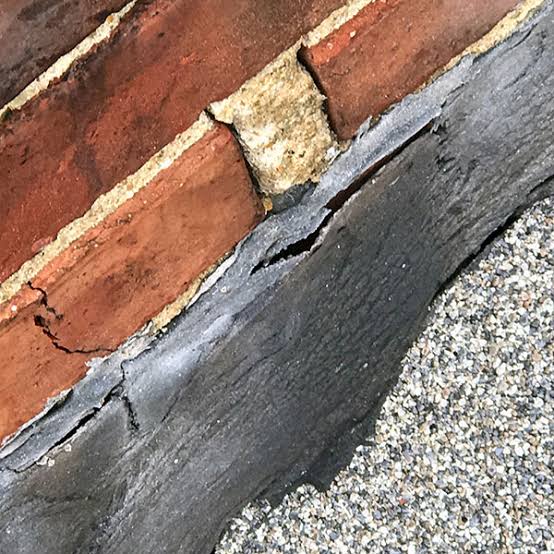
4. Metal flashing is lifted, rusted, cracked, or separated
From the ground you may be able to see metal lifting away from the masonry, but many flashing failures require a roof-level inspection. Red rust, pinholes, bent corners, missing pieces, open seams, or metal that moves when lightly tested by a professional are all reasons to repair or replace the flashing rather than coat it with another layer of sealant.
5. Roof cement or caulk has been applied repeatedly
Heavy black roofing cement around a chimney often tells a story: the leak has happened before. Sealant has legitimate uses, but it should not replace a properly layered flashing assembly. Large amounts of tar, caulk, or patch material can hide failed metal and make the eventual repair more difficult. If the same area has been patched several times and the leak returns, the underlying flashing detail should be opened and evaluated.
6. Shingles are damaged or unusually worn around the chimney
Cracked, lifted, soft, or mismatched shingles beside a chimney can allow water into the same area as a flashing failure. Sometimes the shingles are the cause; sometimes they were damaged during an earlier flashing patch. A complete diagnosis should check how the shingles, underlayment, and flashing overlap rather than treating each component separately.
7. Interior paint or drywall is peeling beside the chimney chase
Persistent moisture can cause paint to blister, drywall tape to loosen, plaster to discolor, or trim to swell. These symptoms may appear slowly, especially when a small leak wets the wall cavity repeatedly instead of producing visible dripping. By the time interior finishes are damaged, the insulation or wood behind them may have been exposed to moisture for a while.
8. The problem returns after the roof was recently replaced
A new roof should not leak around the chimney. If it does, the flashing may have been reused, integrated incorrectly with new shingles, or left dependent on sealant. The chimney masonry may also have an independent defect that was not addressed during roofing work. A post-replacement leak is a reason for a detailed inspection of the transition—not proof that the entire new roof is defective.
9. You see staining only after snow, ice, or freeze-thaw weather
Northern New Jersey winters repeatedly move moisture through freezing and thawing. Small openings in mortar, flashing joints, and roofing transitions can widen over time. Snow collecting behind a chimney may also melt slowly and expose the flashing to water for longer than a normal rainstorm. If the leak is seasonal, document when it appears; that timing helps the inspector narrow down the cause.
Is It Really the Flashing? Other Chimney Problems That Look Like Roof Leaks
Not every stain beside a chimney means the flashing has failed. The roof and chimney form one exterior system, so the inspection should include the masonry above the roofline as well as the roofing below it. The table below shows the most common look-alike problems.
| Possible Source | Typical Clues | What a Pro Should Check |
|---|---|---|
| Failed step/counter-flashing | Leak near chimney during rain; loose or patched metal; wet decking at roof-to-masonry joint | Metal condition, overlaps, shingle integration, back-pan/cricket, underlayment |
| Cracked chimney crown | Moisture can enter masonry from the top and migrate downward | Crown cracks, slope, overhang, seal between crown and flue |
| Damaged mortar or brick | Spalling brick, open joints, white staining, damp masonry | Repointing needs, brick condition, water absorption, structural movement |
| Missing/damaged chimney cap | Water enters flue opening; debris or animals may enter | Cap fit, corrosion, attachment, flue exposure |
| Shingle/underlayment failure | Damage extends beyond chimney or follows a roof slope | Shingle age, fasteners, underlayment, storm damage, decking |
| Condensation | Moisture may occur without rain, especially in cold weather | Attic ventilation, bathroom exhaust, flue condition, temperature patterns |
When the masonry itself is part of the problem, see BlueSky’s chimney repair services. Treating failed flashing while ignoring cracked brick, mortar, or a deteriorated crown can leave another route for water.
Chimney Flashing Repair vs. Full Flashing Replacement
A small repair can be appropriate when the metal is fundamentally sound and the defect is isolated—for example, one loose section of counter-flashing or a localized shingle integration problem. Full replacement is usually the stronger choice when the flashing is badly corroded, incorrectly installed, buried under layers of patch material, or repeatedly leaking.
A targeted repair may make sense when:
- The leak source is clearly isolated and the surrounding metal is still in good condition.
- Only a small counter-flashing section has pulled away and can be properly reset or replaced.
- Nearby shingles and roof decking are dry and structurally sound.
- The original flashing geometry and overlaps were installed correctly.
Replacement is usually safer when:
- The metal is rusted, thin, perforated, bent, or installed as one continuous piece where step flashing should have been used.
- The chimney has leaked more than once despite caulk, roof cement, or patch repairs.
- A roof replacement was completed but old flashing was reused or poorly tied into the new shingles.
- Decking or underlayment around the chimney has water damage and the area already needs to be opened.
- Masonry repairs require removal of the existing counter-flashing.
The goal is not to replace more than necessary. It is to restore the correct water-shedding sequence. Metal should direct water onto the roof surface, each layer should overlap the layer below it, and the masonry detail should prevent water from getting behind the metal. If a proposal relies primarily on exposed sealant to accomplish those jobs, ask how the repair will perform when that sealant ages.
How Much Does Chimney Flashing Repair Cost in Somerville, NJ?
There is no single flat price for chimney flashing repair because chimney size, roof pitch, access, metal condition, masonry condition, and hidden wood damage vary from house to house. BlueSky’s current 2026 location content elsewhere on the site lists about $350 to $700 for chimney flashing repair in a standard county pricing example, while BlueSky’s Newark roof guide uses a broader $400 to $1,200 planning range for chimney flashing repair or replacement. Those figures are useful budgeting references, not fixed Somerville quotes.
| Scope | What Can Push the Price Higher |
|---|---|
| Minor flashing correction | Easy access, limited area, sound shingles and decking may keep work toward the lower end. |
| Partial metal replacement | Custom cuts, steep roof pitch, difficult access, or multiple chimney sides increase labor. |
| Full step + counter-flashing replacement | Removal of shingles, new metal, masonry cuts/reglets, underlayment work, and rebuilding the waterproofing sequence increase scope. |
| Flashing plus masonry/wood repair | Rotted decking, deteriorated brick/mortar, crown repairs, or a cricket modification can move the project beyond a basic flashing repair. |
The most useful estimate is one that identifies the source of the leak and explains exactly what is included. Ask whether the quote covers shingle removal and replacement, new step flashing, counter-flashing, back-pan work, sealant only where appropriate, damaged decking, cleanup, and any masonry work. A low number with a vague scope is difficult to compare with a complete repair.
What a Proper Chimney Leak Inspection Should Include
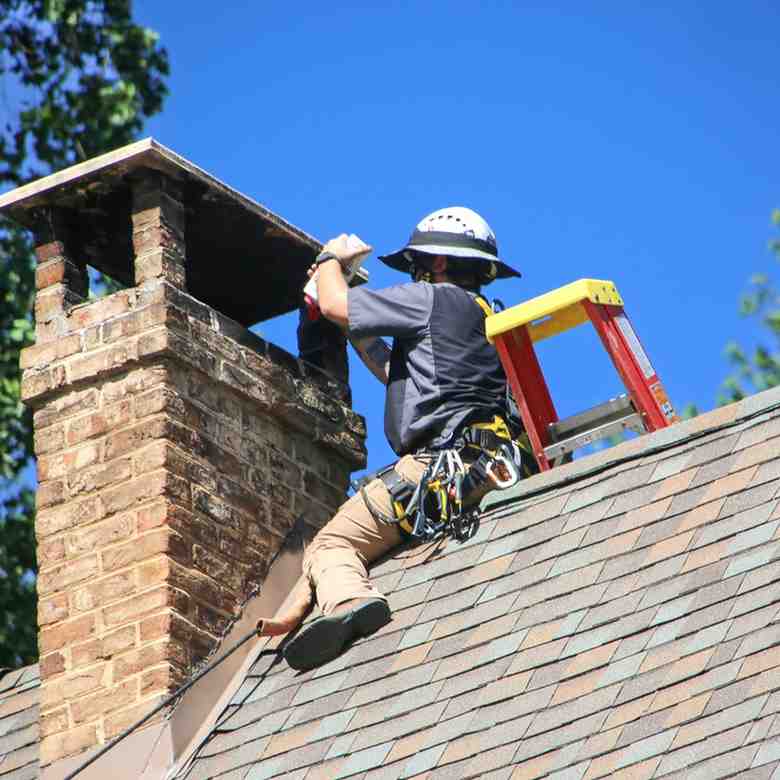
A chimney leak inspection should be broader than looking for a visible hole. Because water moves, the roofer needs to inspect the roof from above and, when accessible, look for moisture evidence from the attic or interior. The sequence matters: first confirm how the exterior is supposed to shed water, then trace where that system has failed.
- Inspect shingles and underlayment around all four sides of the chimney.
- Check step flashing on the sidewalls and counter-flashing where metal meets masonry.
- Inspect the uphill back-pan and determine whether water or snow is collecting behind the chimney.
- Look for rust, holes, open seams, loose metal, failed previous repairs, and excessive roof cement.
- Evaluate brick, mortar joints, the chimney crown, and the cap for independent water-entry points.
- Check roof decking and attic framing for staining, softness, mold-like growth, or repeated moisture exposure.
- Review nearby gutters and drainage where overflow could mimic or worsen a chimney-area leak.
If drainage is contributing to the problem, BlueSky also provides gutter services so the repair can address where the water is coming from, not only where the stain appears.
Why Chimney Leaks Deserve Extra Attention on Older Somerville Homes
Somerville has a strong historic identity, and the Borough’s Historic Advisory Committee specifically focuses on promoting and preserving local architectural heritage. That matters for roofing because older houses often include masonry chimneys, additions from different eras, plank roof decking, older flashing methods, and previous patch repairs that do not match modern roof systems.
An older chimney may also move differently from the surrounding roof. Mortar joints can erode, brick can absorb water, and earlier counter-flashing may have been cut into the masonry in a way that complicates replacement. The answer is not automatically to replace everything. It is to inspect the complete assembly and preserve sound materials while rebuilding failed waterproofing details correctly.
Permit and municipal requirements can depend on the exact scope. Somerville’s code ties building permits to the New Jersey Uniform Construction Code, while routine maintenance and more substantial structural work can be treated differently. If a repair expands into chimney rebuilding, structural roof work, or a visible change to an older property, verify the requirements with the Borough or your contractor before work starts.
What to Do If Water Is Actively Leaking Around Your Chimney
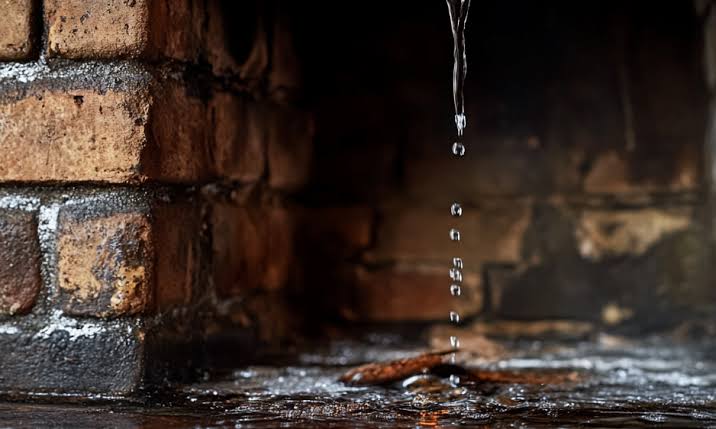
- Protect the interior first. Move furniture and valuables, place a container under drips, and keep water away from electrical fixtures.
- Photograph the stain and note the weather conditions. Record whether it appears during light rain, wind-driven rain, snow melt, or only after long storms.
- Do not climb onto a wet or icy roof. Chimney areas can be steep, slippery, and difficult to access safely.
- Avoid assuming that interior caulk will stop the problem. Water must be stopped at the exterior entry point.
- Schedule a roof/chimney inspection before the next storm if possible, especially if insulation, decking, or drywall is already wet.
A temporary tarp or emergency seal can be appropriate when weather prevents a permanent repair, but it should be treated as stabilization. Once conditions are safe, the flashing and surrounding roof should be opened or inspected closely enough to confirm the actual failure.
Why “Just Caulk It” Often Fails Around Chimneys
Caulk and roofing sealants are not inherently bad. They are useful at specific joints and terminations. The problem is using them as a substitute for flashing. A chimney is exposed to heat, cold, UV light, water, and movement. Thick exposed beads of sealant eventually shrink, crack, separate, or trap water behind them.
Proper flashing works mainly through geometry and overlap. Water is redirected before it can reach the vulnerable joint. Sealant is a secondary detail, not the primary roof. This is why a correctly rebuilt step-and-counter-flashing system generally provides a more durable solution than repeatedly coating the same leak with roof cement.
How to Compare Chimney Flashing Repair Estimates in Somerville
- Ask what the contractor believes is actually causing the leak and what evidence supports that diagnosis.
- Confirm whether the price is for a patch, partial flashing repair, or complete flashing replacement.
- Ask whether shingles must be removed and replaced to install step flashing correctly.
- Find out how damaged roof decking or underlayment will be priced if hidden deterioration is discovered.
- Confirm whether masonry repairs are included or quoted separately.
- Ask how the uphill side of the chimney will be flashed and whether a cricket or improved back-pan detail is appropriate.
- Verify contractor licensing, insurance, written warranty terms, cleanup, and disposal.
BlueSky lists New Jersey License #13VH13982000 and describes itself as a family-owned, fully insured contractor with more than 45 years of experience. Before choosing a contractor, you can also review completed projects and customer reviews to evaluate the company beyond the estimate itself.
Frequently Asked Questions About Chimney Flashing Repair in Somerville, NJ
How do I know if my chimney flashing is leaking?
Common signs include ceiling stains near the chimney, damp attic decking, peeling paint or drywall, rusted or lifted metal, repeated caulk patches, and leaks that worsen during wind-driven rain. Because crown, mortar, cap, and shingle defects can look similar, a roof-level inspection is the best way to confirm the source.
Can chimney flashing be repaired without replacing the roof?
Yes. If the surrounding roof is in good condition and the problem is localized, the shingles around the chimney can often be carefully removed as needed, the flashing repaired or replaced, and the roofing restored. A full roof replacement is not automatically necessary just because the chimney flashing leaks.
Can a roofer fix chimney flashing, or do I need a mason?
A roofing contractor commonly handles the roof-side flashing system. If the repair also involves deteriorated brick, mortar joints, crown damage, or structural chimney work, masonry skills may be needed as well. A contractor that works on both roofing and chimney/masonry systems can be useful when the leak crosses that boundary.
How long should chimney flashing last?
Service life depends on the metal, installation quality, masonry condition, roof replacements, and exposure. Properly installed metal flashing can last for many years, but it should be inspected whenever the roof is replaced and whenever a leak develops near the chimney. Reusing old flashing during a new roof installation is not always the best long-term choice.
Does insurance cover a chimney flashing leak?
Coverage depends on why the damage occurred and the terms of the policy. Sudden storm damage may be treated differently from long-term deterioration, improper maintenance, or gradual leakage. Document the damage, prevent additional interior loss, and contact your insurer if the leak followed a covered weather event.
How much does chimney flashing repair cost in Somerville?
BlueSky does not publish one fixed Somerville price. Current 2026 BlueSky content uses planning figures of roughly $350 to $700 for chimney flashing repair in one county pricing example and $400 to $1,200 for flashing repair or replacement in a Newark guide. Chimney size, pitch, access, masonry, and hidden decking damage can move the final cost outside those ranges. An inspection is needed for an exact written estimate.
Should I replace flashing when I replace my roof?
The chimney flashing should always be evaluated during a roof replacement. If existing metal is damaged, incorrectly installed, heavily patched, or difficult to integrate reliably with the new roofing system, replacement is usually the better long-term choice. The contractor should explain whether flashing is being replaced, reused, or modified before the project begins.
Get a Chimney and Roof Leak Inspection in Somerville, NJ
If you have a water stain beside the chimney, a leak that keeps returning, or visible flashing that looks loose or heavily patched, address it before moisture reaches more of the roof deck, insulation, drywall, or framing. The repair may be relatively localized when it is caught early.
BlueSky Roofing & Siding Solutions provides roofing, chimney, gutter, masonry, and exterior services across New Jersey and lists Somerset County among its service areas. The company is family-owned, has more than 45 years of experience, and lists NJ License #13VH13982000.
Request a free estimate or call (201) 686-1059 to schedule an inspection for a roof leak or chimney flashing problem in Somerville, NJ.

